What It Is
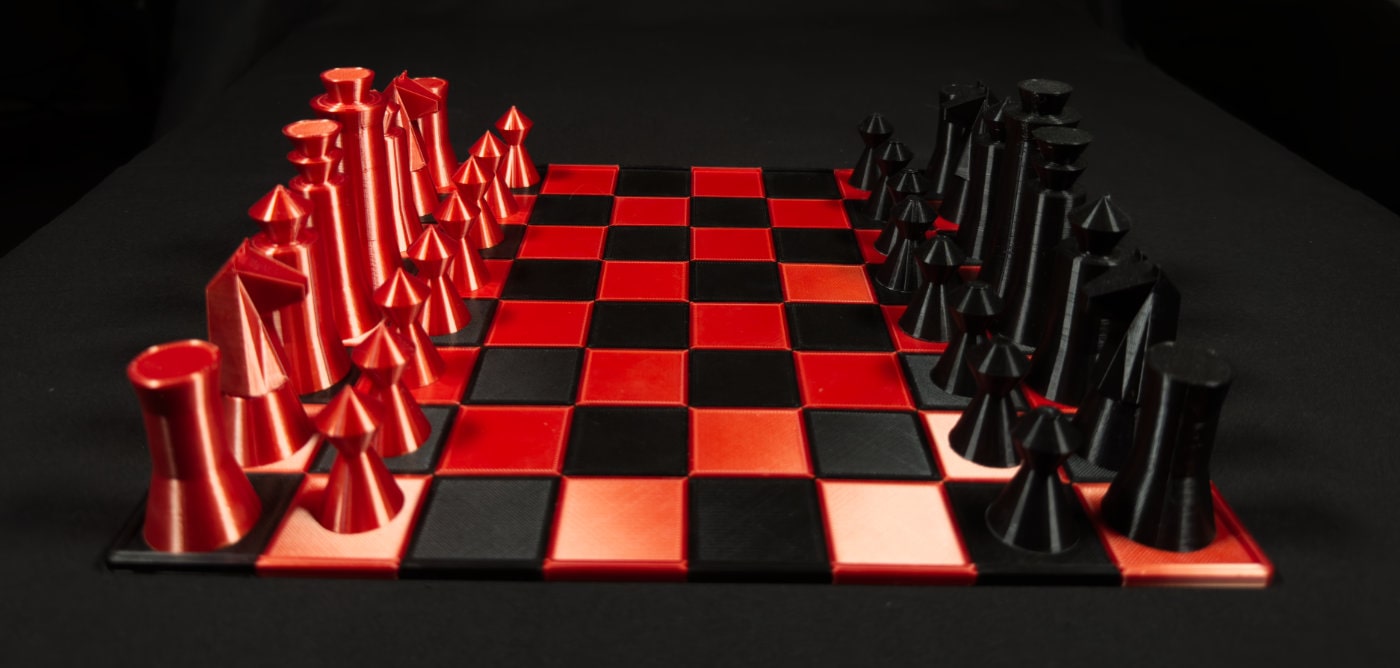
A complete 3D recreation of Alexander Gelman's ultra-rare limited edition chess set, originally created in collaboration with traditional Japanese artisans. While only 5 exist in the world (made of lacquer, silver plating, and gold leaf, priced up to $55,000), I recreated the entire set using 3D modeling and printing—working from just three reference photos.
- 32 chess pieces modeled from limited photographic references
- Minimalist geometric design faithful to the original
- 3D printed in PLA plastic using consumer-grade printer
- Functional playable chess set
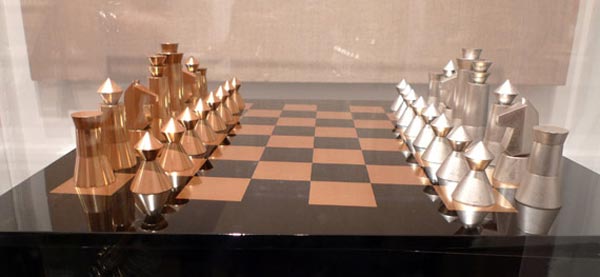 One of only three reference photos available of the original $55,000 Gelman chess set.
Why I Built This
While learning 3D modeling in Blender, I was challenged to create a chess set. I didn't want to model just any chess set—I wanted something that would push my skills and force me to work with constraints. So I set out to find the rarest, most challenging chess set I could find.
That's when I discovered Alexander Gelman's masterpiece. Here was a chess set so exclusive that only 5 exist in the world, each handcrafted with Japanese artisan techniques and priced at $55,000. The design was stunning: pure geometry, minimalist elegance, and absolutely no 3D model files available anywhere. Just three photos from different angles.
The challenge was perfect: recreate something extraordinarily rare using only visual references. It would test my ability to extrapolate 3D forms from 2D images, work with limited information, and reverse-engineer a design from photographs alone.
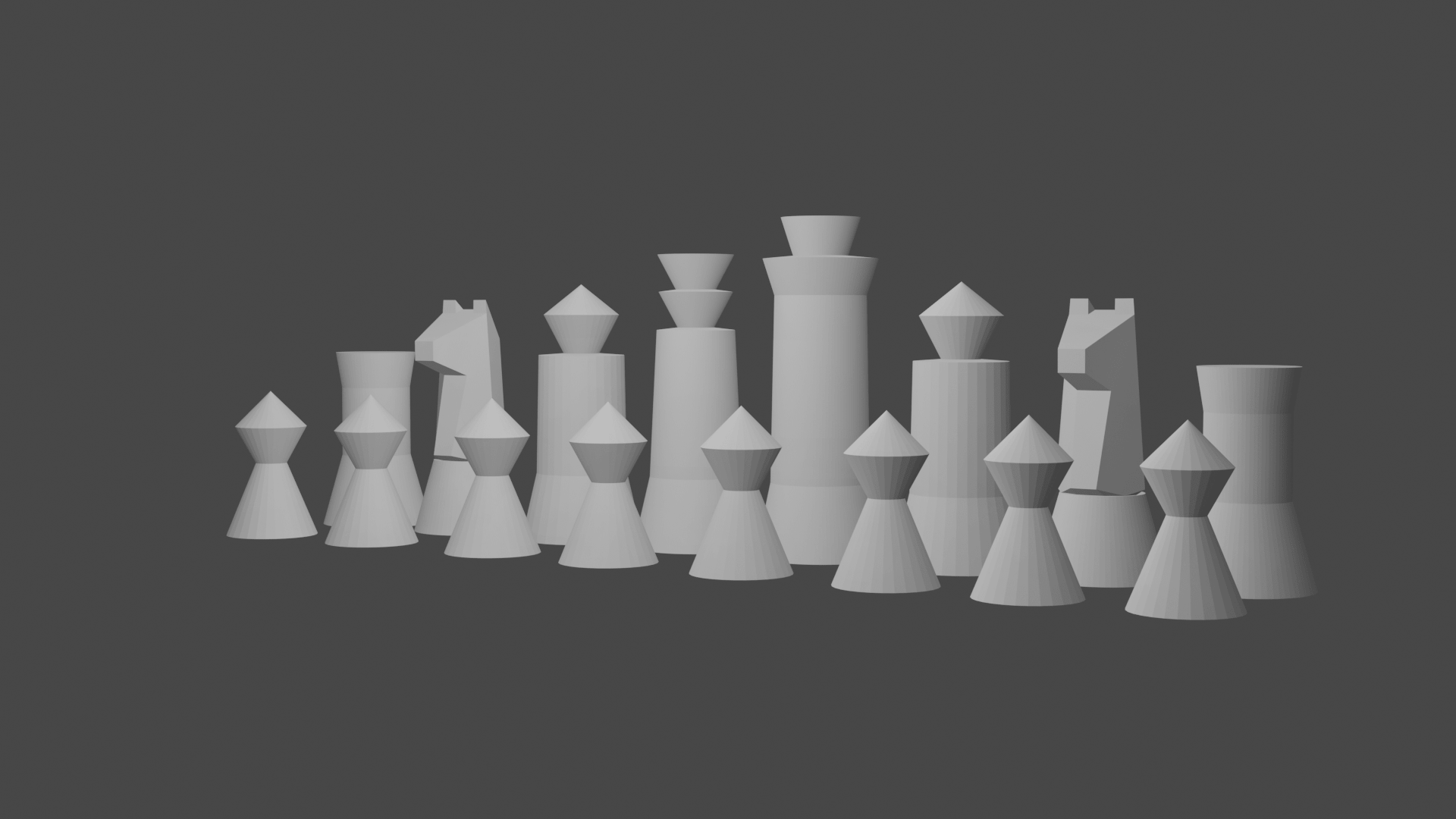 3D render of the modeled chess set in Blender before printing.
How It Works
The modeling process relied entirely on photogrammetric estimation—using the available reference photos to infer dimensions, proportions, and geometric relationships. I imported the three reference images into Blender as background reference planes, then traced the silhouettes to establish basic proportions.
Fortunately, Gelman's design uses simple geometric primitives: cylinders, cones, cubes, and pyramids with clean boolean operations. Each piece was modeled by analyzing its profile from multiple angles, creating the base geometry, and refining proportions until they matched the reference photos. The minimalist design meant I could focus on getting the ratios right rather than complex organic forms.
Once modeled, I exported each piece as an STL file and sliced them for 3D printing using Cura. The pieces were printed in PLA plastic on a consumer-grade FDM printer, then sanded and finished to match the clean lines of the original.
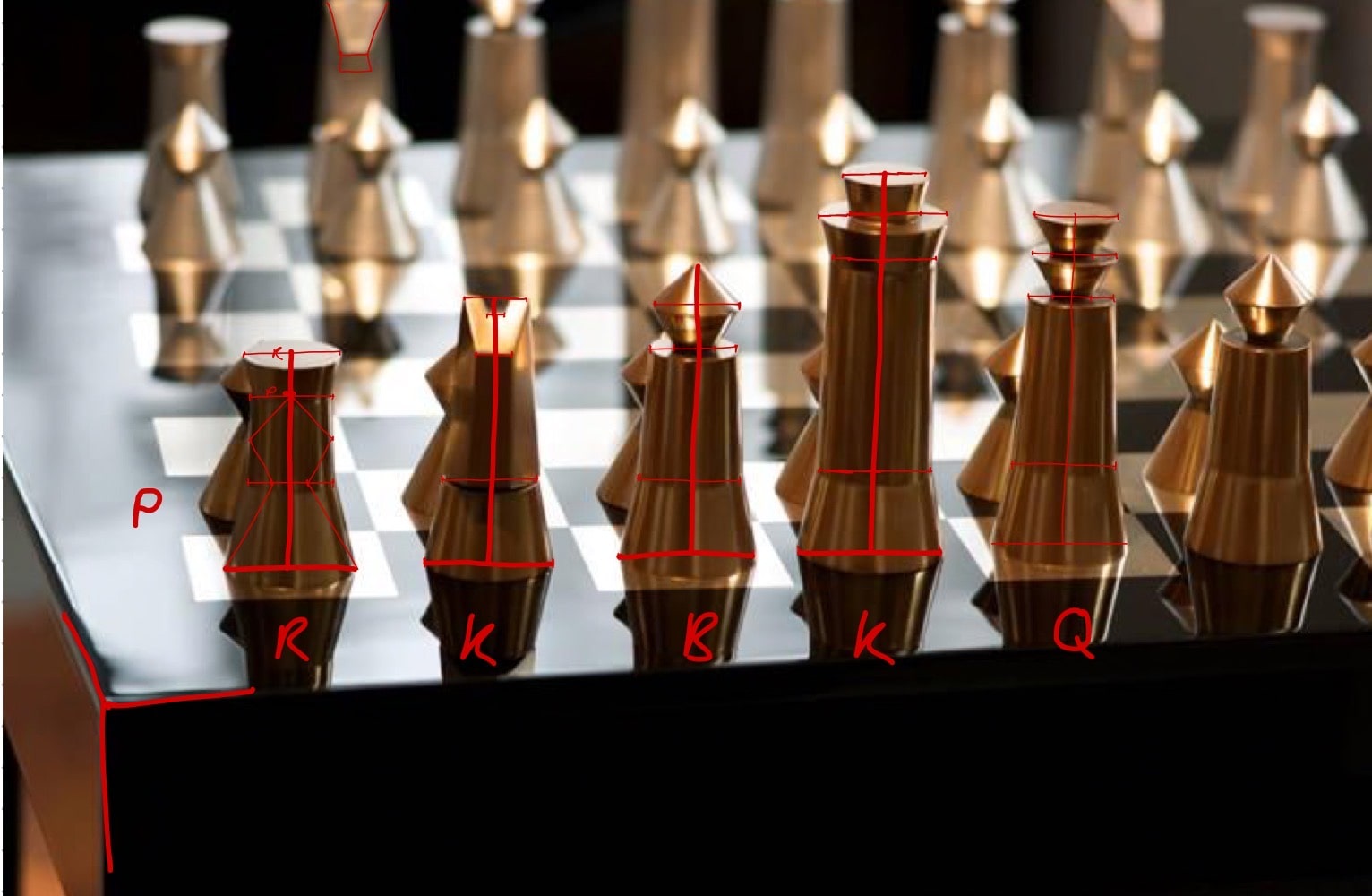 Reference photo used to model the rook piece—inferring 3D form from 2D images.
Technical Details
Tools used:
- Blender: 3D modeling and rendering
- Cura: Slicing software for 3D printing
- FDM 3D Printer: Consumer-grade printer (PLA filament)
- Photo references: Only 3 publicly available images
Design constraints:
- No official measurements or blueprints available
- Had to extrapolate 3D geometry from limited 2D photos
- Maintained proportional accuracy relative to reference images
- Simplified some details that weren't visible in photos
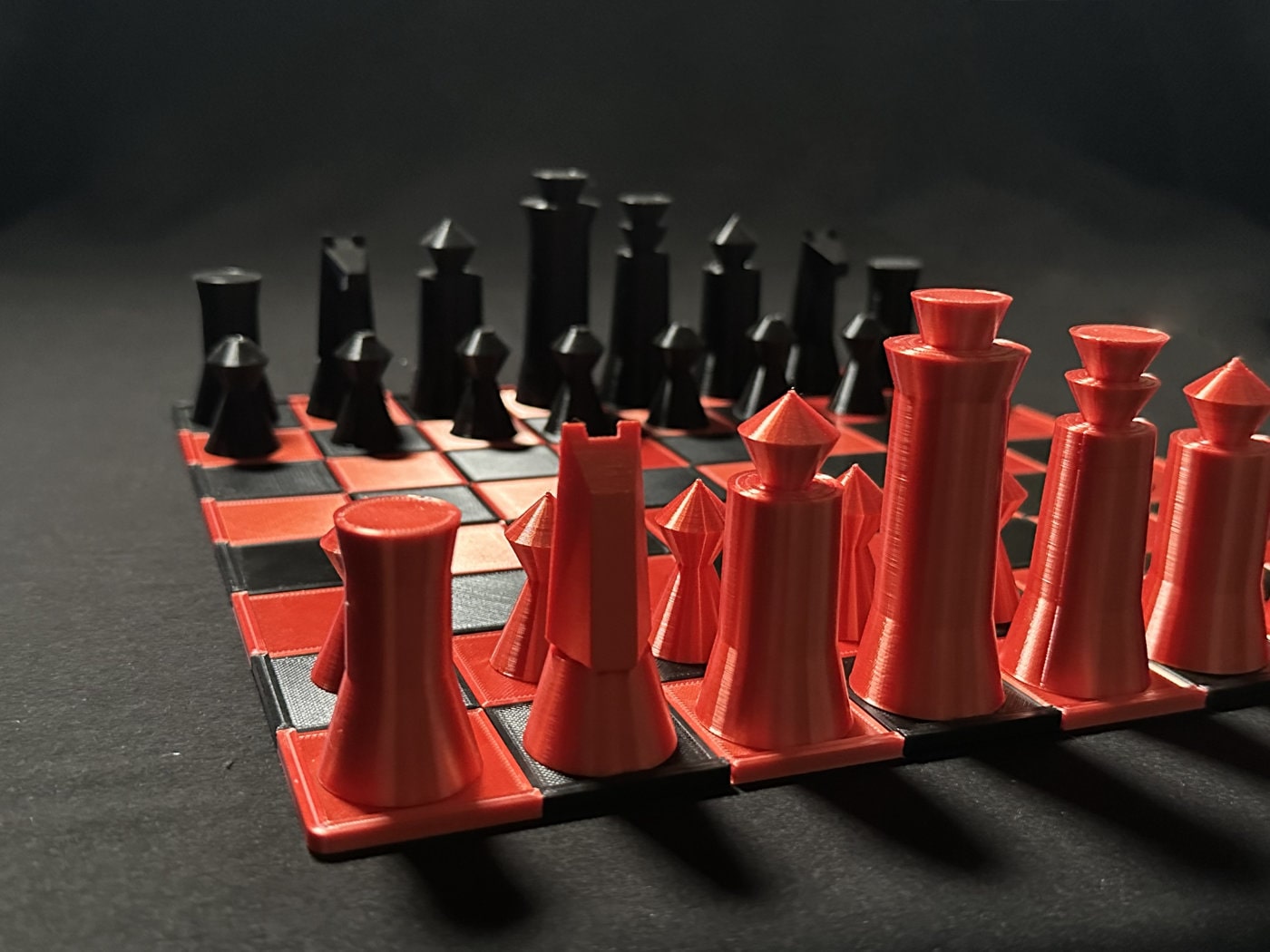 Printed rook pieces compared to reference—accuracy validated through iterative modeling.
Challenges & Solutions
Limited reference material: With only three photos, I had to make educated guesses about hidden geometry and piece details. I solved this by assuming geometric consistency—if the rook followed certain proportions, the other pieces likely did too. I also used the chessboard grid as a scale reference to maintain relative sizing.
Inferring 3D from 2D: Translating flat photos into 3D models required careful analysis of shadows, highlights, and perspective. I traced silhouettes from multiple angles and cross-referenced them to ensure geometric accuracy. When details were unclear, I defaulted to the simplest geometric interpretation consistent with the minimalist design.
Print accuracy: Consumer-grade 3D printers have limitations in resolution and surface finish. I compensated by designing slightly larger tolerances for interlocking parts and post-processing printed pieces with sanding to achieve smooth surfaces matching the original's clean aesthetic.
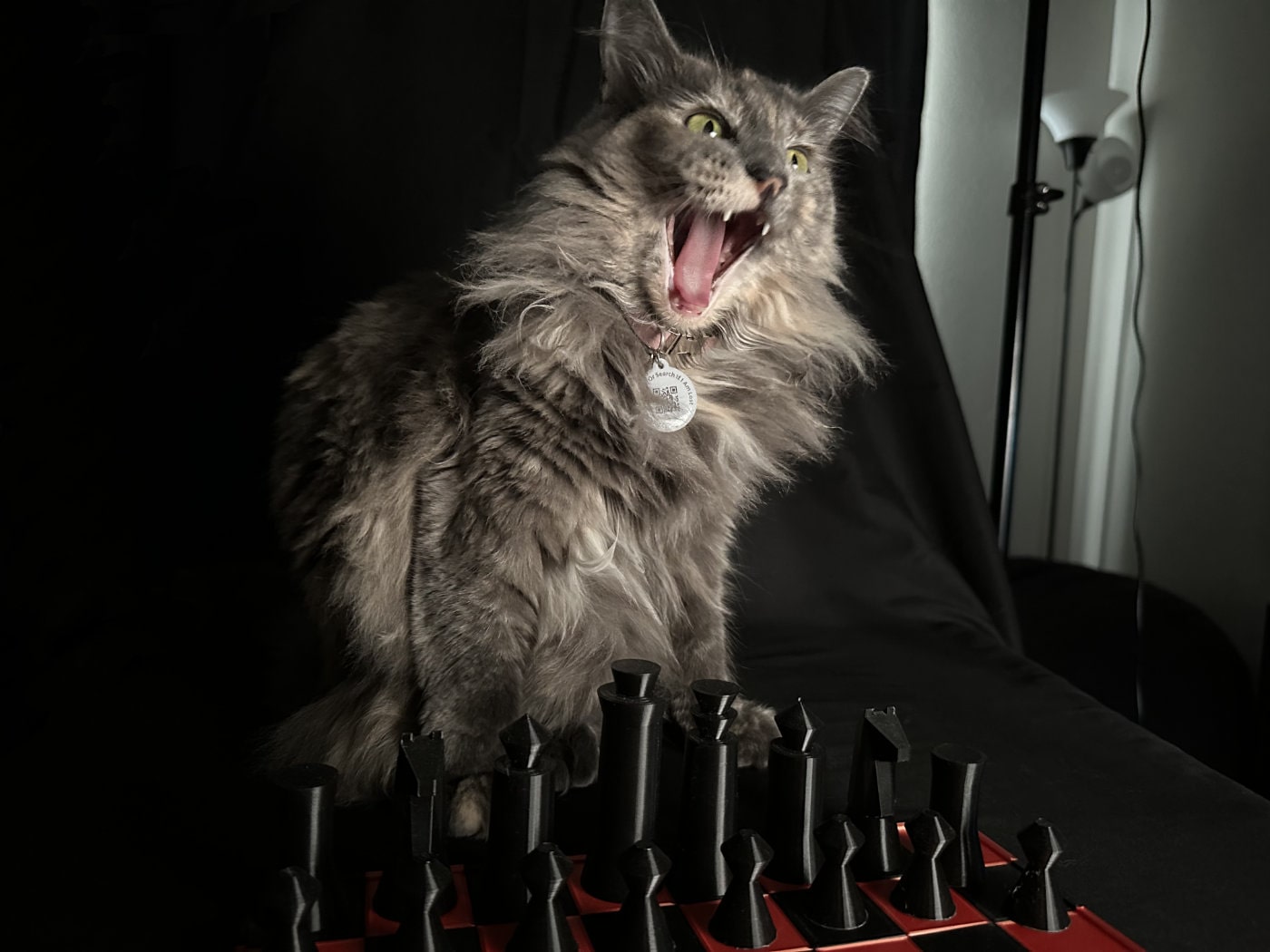 Unexpected quality assurance: cat-approved durability testing.
What I Learned
This project taught me the fundamentals of photogrammetric modeling—how to reverse-engineer 3D objects from limited visual references. I learned to analyze shadows, perspective, and proportions to infer geometry that isn't explicitly visible. I also gained a deep appreciation for how much information can be extracted from a small number of well-composed reference images.
I learned that constraints breed creativity. Working with only three photos forced me to develop problem-solving strategies I wouldn't have needed with complete reference material. I had to trust my geometric intuition and validate my assumptions through iterative modeling and test prints.
Most importantly, I learned that you don't need expensive tools or perfect information to recreate something extraordinary. A consumer 3D printer, free modeling software, and determination can reproduce a $55,000 masterpiece—at least in form, if not in gold and lacquer.
Impact
By the numbers:
- 32 pieces modeled from 3 reference photos
- Cost: ~$5 in PLA filament vs. $55,000 original
- Print time: ~40 hours total for full set
- One of the only known 3D recreations of this set
What changed:
- Proved I could reverse-engineer complex designs from minimal references
- Built confidence in 3D modeling and photogrammetric techniques
- Created a functional, playable chess set I actually use
- Made an ultra-rare design accessible (at least in plastic form)
Links
- Original Design: Alexander Gelman Chess Sets (Luxuo)
- Code/Models: Private (3D model files not publicly available)